Insights
The Biggest AI Risk Facing Organisations Is Not Weak Governance
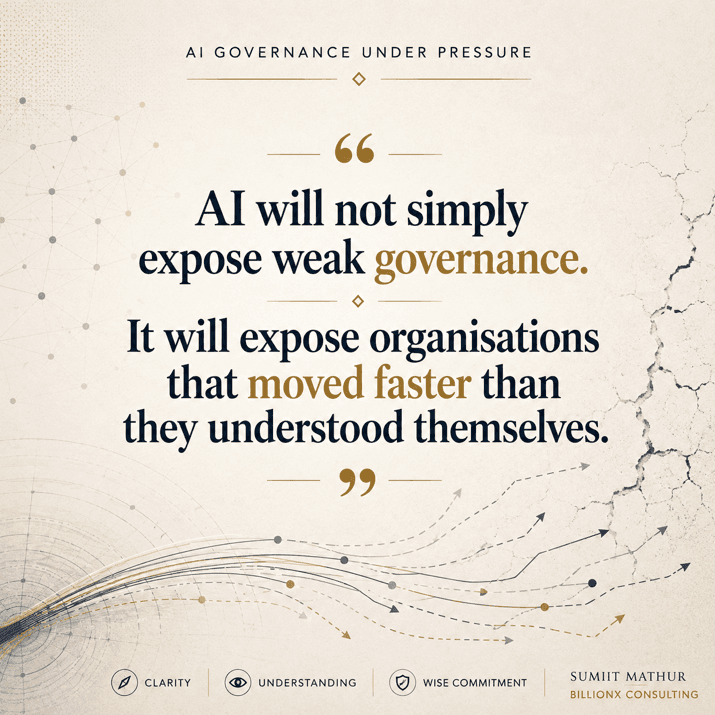
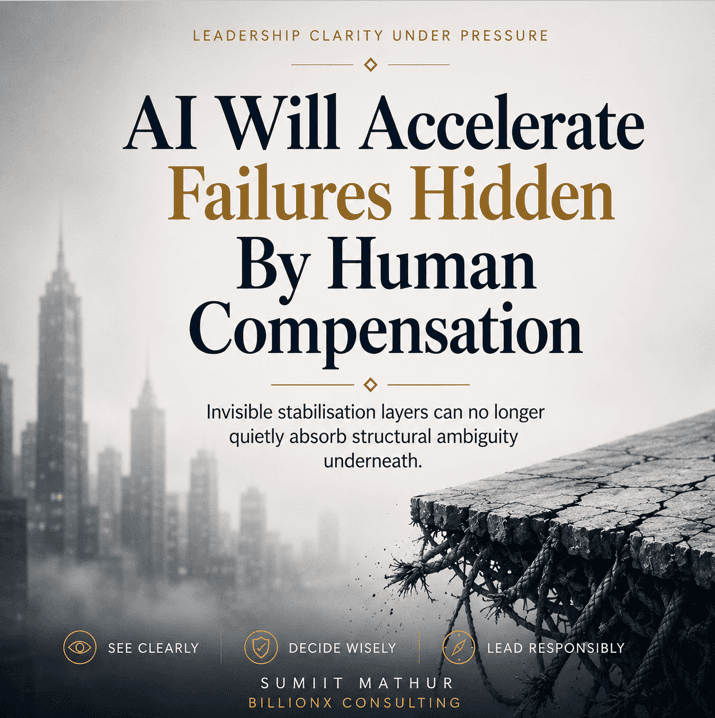
"The real AI risk is not poor implementation - it is scaling organisational confusion at machine speed. AI will not simply expose weak governance. It will expose organisations that accelerated before leadership had fully made sense of what they were actually building."
The AI buzz is increasing rapidly, and conversations around AI governance are becoming louder - understandably so. AI experimentation and adoption continue to accelerate globally, but some of the numbers behind that momentum reveal a deeper tension beneath the surface.
. McKinsey continues to report major gaps between AI adoption and governance maturity.
. A Grant Thornton survey found that more than three-quarters of senior leaders lack confidence their organisation could pass an independent AI governance audit.
. PwC also reported that 56% of CEOs are seeing little or no financial benefit from AI investments.
As most organisations evolve through the AI adoption journey, there is naturally an increasing need to govern how AI integrates into the business. But the pressure to move quickly is also creating a different kind of risk beneath the surface.
Many organisations are embedding AI into environments where leadership teams are still trying to understand what truly matters, what needs to change, and the future they are actually preparing for.
Weak organisational clarity often creates inefficiency, fragmented execution and wasted investment. With AI embedded into the organisation, those same weaknesses can scale faster, spread wider, and become harder to detect before large-scale damage becomes difficult to reverse.
The real AI risk is not poor implementation. It is scaling organisational confusion at machine speed.
What truly matters first is whether Boards, Executives and senior leadership teams have created enough space for the right conversations. Not simply around governance structures, policies or implementation activity, but around the future the organisation is actually moving toward, whether intentionally or in response to changing market realities.
Under pressure, organisations can become very busy before leadership teams become genuinely clear. Those conversations often surface priorities never fully articulated, assumptions that were never challenged, and tensions hidden beneath organisational momentum.
What once felt like separate problems can start revealing deeper patterns around priorities, decision-making, focus and where the organisation may already be drifting.
In many organisations, the challenge is no longer the technology. It is whether leadership teams are clear enough, aligned enough, and honest enough about the organisation's reality before AI begins amplifying it further.
Ultimately, the extent to which organisations realise the value from AI may depend less on the technology itself, and more on the organisation's readiness to adapt around it.
AI will not simply expose weak governance. It will expose organisations that accelerated before leadership had fully made sense of what they were actually building.
This article was originally published on LinkedIn on 9 May 2026.
Continue Reading
Found this useful?
Let's explore what this means for your organisation.
A focused 45-minute conversation — no slide decks, no pitch. Just candid, senior-level thinking about what you're navigating.
Start a Conversation