Insights
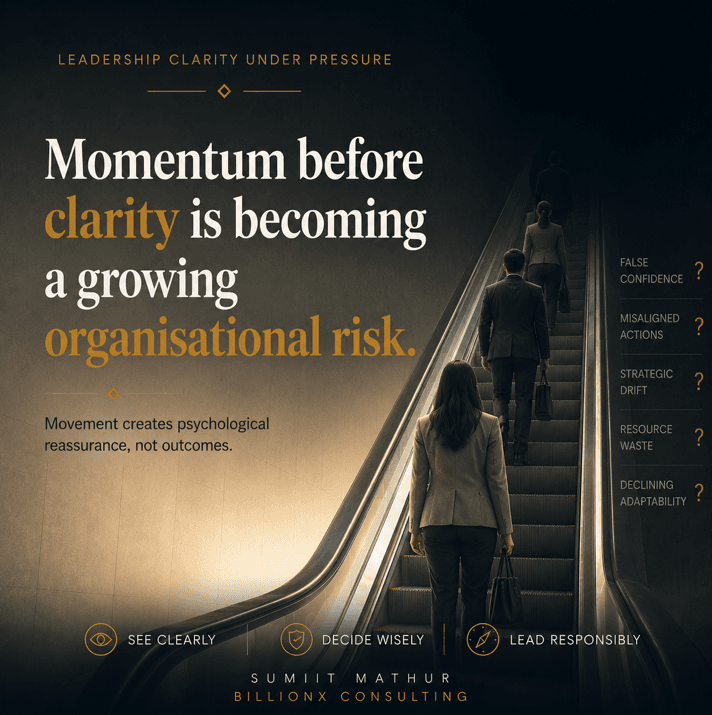
Momentum Before Clarity Is Becoming A Major Organisational Risk
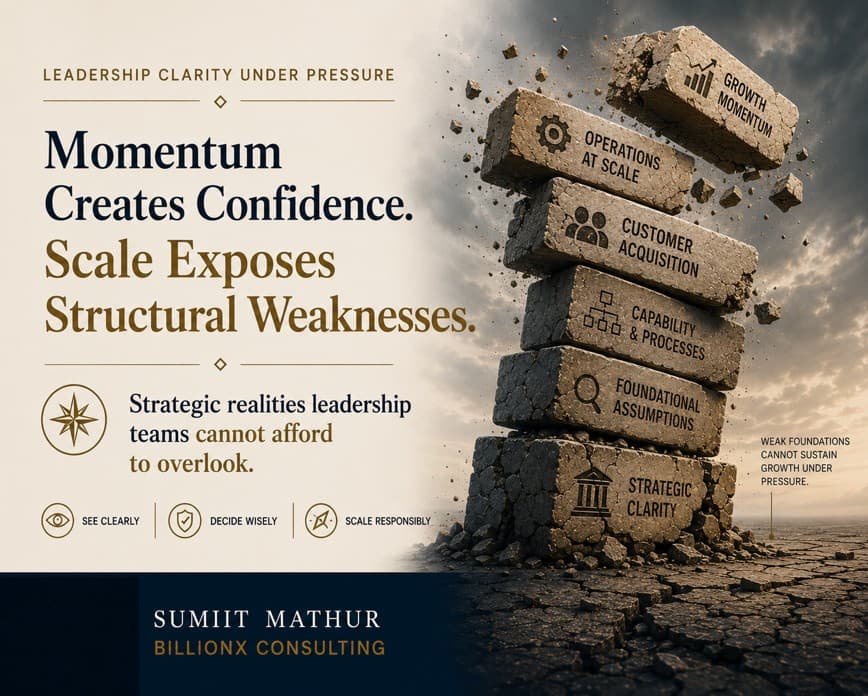
"Movement creates psychological reassurance, not outcomes. Once significant organisational energy aligns around a direction, reassessing underlying assumptions later becomes far more difficult - and reversal can be very costly."
One of the harder periods for Boards and Executives is when the external environment changes faster than internal understanding can mature around it. The volume of competing signals, pressure and uncertainty starts accelerating decision-making before collective clarity has properly formed.
Sometimes it is triggered by a competitor fundamentally changing its business model and shifting market expectations almost overnight. Sometimes it is the rapid onslaught of new technology - like the growing pressure surrounding AI - where suddenly every conversation, vendor and industry discussion seems to imply that immediate movement toward AI is now synonymous with staying relevant.
That external noise creates enormous pressure.
Boards want confidence that the organisation is not falling behind. Executives want to demonstrate responsiveness and momentum, while stakeholders begin expecting visible signs that action is already underway.
So organisations begin moving.
AI strategies get commissioned. Roadmaps evolve rapidly. New programs emerge, structures shift, investment accelerates and delivery activity starts building across the organisation.
And over time, the movement itself can start creating psychological reassurance. Visible activity begins creating the feeling that progress is occurring, leadership is in control and uncertainty is gradually reducing.
But the pressure to maintain momentum can also quietly reduce the space required for deeper strategic reflection and shared interpretation. Important assumptions receive less challenge under urgency, while leadership itself may still be trying to answer more fundamental questions around what problems they are actually trying to solve, why they matter and what cannot afford to become destabilised in the process.
That is where the tension quietly begins building.
The organisation can become highly active operationally while collective understanding across leadership remains fragmented, with different executives holding conflicting views of the direction.
More activity, coordination and reporting rarely resolve unclear collective understanding underneath.
Over time, this becomes increasingly difficult to stabilise.
Roadmaps continue evolving as priorities keep shifting with emerging clarity and mis-steps.
Delivery systems repeatedly recalibrate underneath pressure, while the organisation gradually becomes more committed to assumptions that may still be evolving.
In many environments, what becomes valuable during these periods is creating deliberate space for leadership teams to think together more clearly before organisational momentum hardens around assumptions that may still be evolving underneath.
Because once significant organisational energy aligns around a direction, reassessing underlying assumptions later becomes far more difficult - and reversal can be very costly.
This article was originally published on LinkedIn on 17 May 2026.
Continue Reading
Found this useful?
Let's explore what this means for your organisation.
A focused 45-minute conversation — no slide decks, no pitch. Just candid, senior-level thinking about what you're navigating.
Start a Conversation